For most couples, a wedding is a private celebration. For celebrities, athletes, politicians, influencers and prominent business leaders, it rarely is. A well-known guest list, a recognisable name or a venue that leaks online can turn a personal day into a news story, or worse, a safety problem.
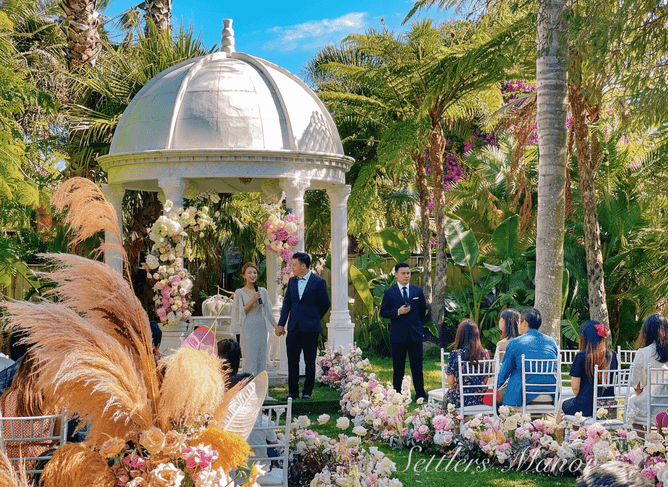
This guide covers what actually goes wrong at high-profile weddings, what good security looks like, what it costs in New Zealand, and what to do if something leaks. It draws on our experience hosting high-profile weddings at Settlers Country Manor, including those of Charisse Uy & Chris Groen and Aafreen Vaz & Ken.
Why VIP Weddings Require Security Planning
A wedding puts a guest list, a venue, a timeline and hundreds of photographs in the hands of many people at once. For a couple with a public profile, any one of those can be the weak point. The most common risks are:
Media and paparazzi. Photographers, journalists and drone operators may try to capture the day from outside the property. For couples with an exclusive magazine or media deal, an early leak can undo the arrangement.
Uninvited guests. A date or venue posted online invites gatecrashers and curious onlookers.
Phones and social media. A well-meaning guest can post the dress, the vows or the couple's location before the couple does.
Vendor access. Florists, caterers, musicians and photographers all see schedules and guest names.
Leaked documents. Invitations, run sheets and guest lists reveal where and when the couple will arrive.
Targeted disruption. Stalkers, activists, overzealous fans and opportunists are rare, but they are the reason security exists at all.
The fix is not paranoia. It is deciding in advance who knows what, who can enter where, and who is allowed to record.
Why a private estate makes the difference
Most of the measures below are easier, and cheaper, at a private estate than at a public venue. Settlers Country Manor and similar estates give couples:
Exclusive use. One wedding on site at a time, so no other party shares the grounds, car park or facilities.
Controlled access. One managed entrance, a checked guest list and a clear rule for who may enter private areas.
Seclusion. Grounds with limited public visibility and sightlines that can be screened with planting, marquee walls or careful positioning.
Private spaces. A separate area for the couple to prepare and rest, out of sight of guests and vendors.
One location for everything. When the ceremony, photos, dinner and dancing all happen on one property, guests are not travelling between venues, which removes several points where privacy can slip.
Discreet staff. Everyone working the day knows the media rules, receives the schedule on a need-to-know basis, and does not post or discuss the event. Bookings and guest details are never shared with other clients or promoted publicly without the couple's written permission.
If your plans involve several locations (ceremony, reception, after-party, VIP accommodation), security needs to be coordinated across all of them, along with transport between each.
Securing the ceremony
The ceremony is when guests are seated, phones are out and the couple is most visible. These measures keep it private without making it feel guarded:
A verified guest list. Names are checked at one entrance by a greeter or security staff. Plus-ones are named in advance, and anyone not on the list waits while the couple's representative is called.
An unplugged ceremony. A short sign and a word from the celebrant ask guests to put phones away. The photographer and videographer are the only people recording.
Drone rules agreed in writing. If your photographer uses a drone, the couple and venue approve the flight plan beforehand. Drones are regulated as aircraft in New Zealand, so confirm the operator knows the current rules, including those for flying over people and private land.
Sightline planning. Position the ceremony away from boundaries, roads and neighbouring properties.
Staggered arrivals. The couple, the wedding party and the guests arrive by separate routes at different times, so the couple is never waiting in public view.
Vendor identification. Every supplier wears a wristband or lanyard, and only those on the day's run sheet go beyond the guest areas.
Positioned security. Staff cover the entrance, the boundary and the couple's private area, with a radio or phone link to the planner.
An emergency plan. The team knows where first aid is, how to reach emergency services quickly, and who decides if the programme must change.
How Executive Protection Works at Weddings
The best security teams, such as Imperial Security, understand that weddings are emotional and highly personal events. Their role is to protect the environment without becoming the center of attention.
Professional executive protection teams typically focus on discretion and prevention rather than visible enforcement. Common strategies include:
Covert Deployment
Many security personnel work in plain clothes so they blend naturally with guests and staff while remaining ready to respond to any situation.
Discreet Communication
Security teams often use subtle communication tools such as earpieces and coordinated protocols to handle issues quietly without alarming guests.
Proactive Risk Prevention
Rather than reacting to problems, experienced security teams work to prevent them in advance by monitoring surroundings, controlling access points, and identifying potential risks before they escalate.
Protecting guest data and digital privacy
Many leaks start with information, not cameras. A guest list, seating plan or run sheet that travels by open email chains or public links can reach people who were never invited.
Limit who holds the list. Share the full guest list only with the planner, venue and security lead. Caterers need numbers and dietary needs, not names.
Use private channels. Keep documents in access-controlled folders, and avoid public wedding websites that show the date, venue and schedule without a password.
Ask guests to wait. A line on the invitation asking guests not to tag the venue or post before the couple does costs nothing and prevents most accidental leaks.
Delete after the day. Ask the planner and venue to remove personal data they no longer need once the wedding is over.
Why would guests need to sign NDAs for the wedding?
A non-disclosure agreement (NDA) gives a couple a written, enforceable promise that what guests see and hear stays private. Couples ask for them for a few common reasons:
Images and video. To stop photos or footage reaching social media or the press before the couple chooses to share them.
Exclusive media arrangements. When a magazine or outlet has bought the story or pictures, early leaks undermine the deal.
Safety. The location, timeline and security arrangements are information a stalker or fan could misuse.
Sensitivities. Guest lists can reveal business relationships, health situations or family circumstances.
An NDA works best when it is short and specific. Cover what is protected (photos, video, posts, the guest list, the timeline), who signs (guests, vendors, staff and the planner), and how long it lasts, for example until the couple posts their own photos. Send it with the invitation or at RSVP, with a friendly note explaining why, so it reads as care rather than distrust.
Where a formal agreement feels too heavy, an "unplugged" request on the invitation and a sign at the entrance still reduces the risk. Have a lawyer draft or review any NDA, since enforceability depends on the wording. This guide is general information, not legal advice.
Vetting security staff and vendors
The people protecting your privacy also see the most of it, so check them before the day.
Licensing. In New Zealand, security guards need a Certificate of Approval. Ask for each guard's, and for the company's licence details, before you sign.
References. Ask for two recent references from private or high-profile events, not only corporate sites.
Confidentiality. Staff and suppliers sign the same confidentiality terms as guests, covering photos, posts and the guest list.
Briefing. Run a short briefing before the event: who is on the list, who may enter private areas, who speaks to media and who to call if something happens.
Phones on duty. Staff keep personal phones away from guest areas. Only the photographer and videographer record.
One point of contact. Name a single person, usually the planner or venue manager, whom security reports to, so instructions never conflict.
How much does wedding security cost in New Zealand?
For a standard wedding, expect roughly NZ$540 to NZ$2,700 plus GST for event security staff, depending on how many guards you need and for how long. The examples below are illustrative, using a baseline of $45 plus GST per guard per hour (one published New Zealand event rate, with a four-hour minimum). Treat it as a floor, not a quote.
Small private wedding (entrance and boundary): 2 guards for 6 hours, about $540.
100 to 150 guests (entrance, grounds and private areas): 4 guards for 8 hours, about $1,440.
Large or high-profile wedding (full-day coverage): 6 guards for 10 hours, about $2,700.
Public figures or specific threats: close protection, quoted individually.
All figures are in NZD, plus GST. Specialist event and close-protection providers typically charge more than a baseline rate, so treat the high-profile tier as a starting point.
What moves the price:
Hours. Setup, ceremony, reception and pack-down all count, and most companies set a minimum shift.
Role and experience. Crowd management, guest-list control and close protection are priced differently.
Timing. Evenings, weekends and public holidays often cost more.
Site size. Large grounds need more people to cover boundaries and entrances.
Get written quotes from at least two licensed providers, and ask to see each guard's Certificate of Approval before the day.
Questions to ask your wedding planner
A confident answer to each of these shows a planner treats privacy as part of the job, not an extra.
Who on your team will see our guest list, schedule and contact details? A good answer names a short list of people, with details shared only as needed.
How do you store and share our documents? Look for access-controlled folders, not open email chains or public links.
Do your staff and suppliers sign confidentiality agreements? The answer should be yes, as standard, and the planner can show the wording.
How do you handle phones, photography and drones on the day? Look for a clear media plan: who may record, an unplugged ceremony, and drone rules agreed in advance.
How do you manage entry and guest verification? A checked list, one managed entrance and a plan for gatecrashers.
Have you run a high-profile or private wedding before, and what did you learn? Specific examples, handled without naming the clients.
What is your plan if photos or details leak? A response lead, a takedown process and a prepared statement.
Will you promote our wedding in your marketing? Only with the couple's written permission, and never before the wedding.
A planner who hesitates, answers vaguely or says "we've never had a problem" without describing a process is worth a second conversation.
What to do in case of information or footage leakage
Act within the first hour: the longer a photo or clip circulates, the harder it is to contain. Agree this plan before the wedding and name one person to run it.
Capture evidence. Take screenshots showing the post, the account name, the link and the time. Do not delete anything yet.
Ask for removal. Contact the person who posted it, privately and politely. If they will not remove it, report it to the platform as a privacy violation.
Find the source. Check who had access: guests, vendors, staff or anyone who received the guest list or timeline. This tells you whether an NDA was breached.
Brief the team. Tell the couple, the planner, the venue and the security lead. One spokesperson handles all contact with media.
Escalate if needed. For a breached NDA, take legal advice. If the content is harmful or threatening, Netsafe can help with online harm in New Zealand. If a business mishandled personal information, the Office of the Privacy Commissioner is the place to complain.
Control the message. Use a short, prepared statement. Do not respond to rumours or engage with commenters.
Tighten up. Once the leak is contained, change what failed: a narrower guest list, a stricter phone policy or a revised vendor briefing.
Most leaks are accidental, such as a guest posting a happy photo, so keep the first request friendly and save formal steps for repeat or deliberate cases.
A wedding privacy checklist
Work through this before the wedding.
Choose a venue that offers exclusive use of the estate
Keep the date and venue off public wedding websites and social media
Share the full guest list only with the planner, venue and security lead
Ask staff, vendors and the planner to sign confidentiality terms
Decide on NDAs for guests, or an "unplugged" request on the invitation
Agree in writing who may photograph, film or fly a drone
Get written quotes and check Certificates of Approval for security staff
Plan staggered arrivals and a private preparation space
Name one person to lead the response if anything leaks
Ask the venue and planner to delete personal data after the wedding
Creating a Private and Unforgettable Celebration
The best security is the kind guests never notice. With the right venue, an experienced planning team and a plan agreed in advance, a high-profile couple can keep their wedding private, and spend the day on what matters: each other and the people they invited.
Planning a private or high-profile wedding? Get in touch with the Settlers Country Manor team to talk through venue exclusivity, access control and how we work with security providers.