Every year, a steady stream of couples from Australia, the UK and the US choose to marry in New Zealand rather than at home. Some are chasing scenery they can't get elsewhere. Some want a smaller but more deliberate guest list and see distance as a natural way to shrink it. Others are blending two families from different countries and decide a neutral third location is fairer than making one side do all the travelling.
Whatever the motivation, the practical questions are usually the same: is it feasible to marry in New Zealand as a foreigner, what does it cost in time, money and reliability to get guests here, and which part of the country makes sense once you've decided to go. This guide works through all of it in detail.
What Does New Zealand Have to be Considered for Destination Wedding?
Simple Legal Process
This is the detail that surprises most couples once they look into it. A lot of popular destination wedding countries require residency periods, blood tests, notarised translations, or a chain of paperwork that has to be processed through an embassy before you even arrive. New Zealand doesn't.
Couples who are both ordinarily resident overseas give notice of their intended marriage online, through the Department of Internal Affairs' Births, Deaths and Marriages service. Notice generally needs to be given at least three working days before the ceremony, and can be given up to twelve months in advance. Once it's processed, a marriage licence is issued and can be emailed to the couple or their celebrant. From that point, a registered celebrant can perform the ceremony almost anywhere the couple chooses — a beach, a vineyard, a private garden, a registry office. There's no requirement to have lived in the country, and no requirement for a religious ceremony unless the couple wants one.
This matters more than it sounds because it changes what's possible to plan remotely. A couple in London or Los Angeles can complete the entire legal side of getting married in New Zealand without an in-person visit to a government office, coordinating everything by email and video call with a celebrant they never met before the actual wedding.
The English-Speaking Advantage
Set the paperwork aside for a moment and think about the practical things a wedding involves that have nothing to do with government forms:
emailing a florist about seasonal availability
getting on a call with a celebrant to talk through vow wording
briefing a photographer on which family members shouldn't be seated together
negotiating a catering menu, minimum, requirements, and contract
explaining a specific cultural ritual so a venue coordinator can plan around it properly rather than nodding along
asking the venue about the wet-weather or cold-weather backup plan
All of that happens in a first language when you're marrying in New Zealand, and it doesn't in a lot of other popular destinations, independent of how simple or complicated the legal paperwork happens to be. Doing that in a first language, with vendors who don't need anything translated or re-explained, removes a source of friction that's easy to underestimate until you're in the middle of it. And remember, you are dealing with all of that from another time zone, months before meeting in person.
A Mature Tourism and Wedding Industry
This is a practical point that gets less attention than scenery, but it affects almost every part of planning a wedding from overseas. New Zealand's tourism industry is long-established and built around this kind of visitor: English-speaking, planning remotely, often visiting for the first time.
What that looks like in practice:
Vendor reliability and paper trails. Photographers, celebrants, florists and caterers who specialise in weddings are registered businesses with standard contracts, deposit structures, and cancellation terms — not informal arrangements that depend on a personal connection or a local fixer.
Domestic transport infrastructure. Sealed roads connect every region couples would consider, a well-used domestic flight network links major centres, and rental cars are straightforward to arrange with an overseas licence or International Driving Permit.
A wide range of accommodation, from budget to high-end, concentrated in and around the country's main wedding regions, which matters when thirty or fifty guests all need somewhere to stay for several days.
Widely accepted card payments and stable banking, so vendor deposits, final payments, and day-to-day guest spending don't require navigating a cash-heavy or unfamiliar financial system.
Established travel insurance norms and consumer protections, including clear systems for dispute resolution if a vendor doesn't deliver — a useful backstop when you're booking services in a country you may never visit before the big day.
Experience with international weddings. Many photographers, planners and venues in New Zealand's main wedding regions have hosted couples from Australia, the UK, the US and Asia for years and are used to coordinating across time zones, currencies, and guest lists that don't speak the country's other official languages.
Low Crime Rates & Good Supporting Infrastructure
There's also a baseline safety and stability factor that rarely makes it into wedding content but does factor into how comfortable guests feel booking a long-haul trip: New Zealand is consistently ranked among the lower-crime countries globally.
New Zealand also has a well-resourced healthcare system with reciprocal arrangements for some visiting nationalities, and doesn't require couples or guests to navigate the kind of currency instability, infrastructure unpredictability, or safety advisories that may apply to other popular destination wedding countries.
For a couple trying to convince extended family to commit to a long-haul trip, being able to say "it's straightforward and safe" without much qualification removes another point of hesitation from that conversation.
The Range of Breathtaking Scenery
New Zealand is roughly the size of the UK, or slightly smaller than the US state of Colorado, but it packs in an unusual range of landscape:
fjords and glacial lakes in the south
volcanic plateaus and geothermal fields in the central North Island
vineyard country in Marlborough, Hawke's Bay and West Auckland
temperate rainforest along both coasts
beaches that range from white sand in the Bay of Islands to black volcanic sand on the west coast
Most of this is reachable within a few hours' drive of a major town or airport. That density is part of why New Zealand wedding photography tends to look distinctive. Couples aren't choosing between "beach" or "mountains," they're often choosing how many different landscapes they want within a single trip.
Genuine Appeal as a Trip, Not Just a Wedding
Because New Zealand already sits on a lot of people's general travel wish lists, guests are more willing to make the trip here than they would be for a less internationally recognisable location. Many extend the visit into a proper holiday — arriving a week early or staying two weeks after to see more of the country — which changes the calculation for them. They're not just flying a long way for one afternoon, they're using the wedding as the anchor for a trip they wanted to take anyway.
This is a different guest psychology than a lot of other destination wedding locations rely on. A long weekend in the Caribbean or a few days in Bali is often framed to guests as "a nice few days away". But that might not be a trip they'd have planned independently.
New Zealand tends to prompt a different reaction: guests who've never been here describe it as somewhere they'd always meant to visit, which can make the ask land differently. It’s less about "please travel a long way for our wedding" and more "here's finally a reason to go."
How is New Zealand Compared to Other Destination Wedding Countries?
It's worth separating this out from the language question, because paperwork complexity and communication ease are two different problems, even though they often get lumped together under "how easy is it to get married here."
This section is about the legal process — the documents, translations, and government steps required to be married, as distinct from how easily you can talk to your florist.
Bali
Bali is a common comparison point, but the legal picture is more complicated. Indonesian marriage law requires documentation from each party's home country, often including certificates of no impediment, translations into Indonesian by a sworn translator, and in many cases registration or recognition processes back home afterward, since a religious or ceremonial wedding held for foreigners in Bali isn't automatically recognised as a legal marriage in the couple's home country.
Most foreign couples marrying in Bali end up doing the legal registration separately — sometimes at their embassy, sometimes before or after the trip — and treating the Bali ceremony as symbolic. That's a workable approach and plenty of couples are happy with it, but it's a different, more layered process than New Zealand's single-step system, and it requires a local wedding coordinator or agent to manage the paperwork, adding cost and a dependency on an intermediary the couple can't easily verify from overseas.
Mexico
The legal picture in this country varies by state, but marrying legally may require blood tests (in many jurisdictions), documents translated into Spanish by a certified translator, and paperwork processed through a local Civil Registry office — often in person, in Spanish, on local government timelines that don't always move quickly.
Many couples again choose to do a legal signing quietly (sometimes even before travelling) and treat the destination ceremony as symbolic, to avoid navigating that process in a second language under time pressure.
The Caribbean
A number of islands in the Caribbean, including Jamaica, the Bahamas, and various British Overseas Territories, conduct legal proceedings in English and have well-established systems for marrying foreigners, in some cases within a day or two of arrival. Other islands in the area, including the Dominican Republic and other Spanish or French-speaking islands, involve translated documentation and local-language processes similar to Mexico.
The practical point isn't that the Caribbean is harder than New Zealand across the board, but that "the Caribbean" isn't a single legal system, and couples need to check the specific island rather than assume.
Italy
Italy sits in an interesting middle position. Unlike Bali or Thailand, a legal wedding in Italy is a real civil marriage, and many couples do it for exactly that reason. But the process is document-heavy and runs in Italian. Foreign couples need a certificate of no impediment (a nulla osta) issued by the authorities of their country of citizenship, legalised and translated into Italian. Many couples first sign a sworn affidavit (an atto notorio) before their home country’s consulate in Italy, a notary with an apostille, or an Italian court. The embassy then issues the nulla osta, which goes to the town hall (comune) where the wedding will take place. The details vary by nationality. Citizens of some countries, including Germany, Austria and Switzerland, need a certificate of legal capacity to marry from their home civil registry instead. The number of witnesses on the sworn declaration also varies by country.
Because the nulla osta is often obtained after arriving in Italy, couples frequently need to be in the country several days before the ceremony to complete the paperwork, and requirements differ from one comune to the next. So destination weddings in Lake Como might have different comune requirements than in Rome or Capri Island.
The ceremony itself is conducted in Italian, so couples who don’t speak it need an interpreter and two witnesses. Civil ceremonies are held at the town hall or an approved venue, and a Catholic ceremony adds requirements from the church. If the couple wants the marriage recognised at home, they also need an apostilled copy of the marriage certificate afterwards.
For these reasons, many couples hire a local planner or agent to manage the process, or complete the legal marriage separately and treat the Italian ceremony as symbolic.
Thailand
This country sits closer to the Bali and Mexico end of the spectrum than to New Zealand's. Foreign couples generally need to obtain an "Affirmation of Freedom to Marry" from their home country's embassy in Bangkok, have it translated into Thai by a certified translator, get that translation legalised by Thailand's Ministry of Foreign Affairs, and then register the marriage in person at a local district office (an Amphur), where the process is conducted in Thai.
As with Bali, many foreign couples treat the resort ceremony itself as symbolic and either complete the legal registration as a separate, more bureaucratic step during the trip, or register the marriage back home instead. It's a manageable process with the right local coordinator, but — like Bali and Mexico — it's a multi-step, multi-language system rather than the single English-language process New Zealand offers.
Set against that landscape, New Zealand's position is straightforward: one national system, conducted entirely in English, with no requirement for translated documents, blood tests, or a local agent to manage the process. A couple can read the actual government guidance themselves, in their own language, and know what's required without paying someone else to interpret it for them.
That said, the fact that it's in English is a separate advantage from the fact that it's a simple process, so it's worth looking at the communication side on its own terms too.
But Where in New Zealand Should You Get Married?
New Zealand has several distinct regions that regularly host destination weddings, each with a different character, climate, and set of practical trade-offs. There's no single correct choice. It comes down to what a couple is prioritising: scenery type, guest travel burden, weather predictability, or cost. Here's what each of the main options offers.
Queenstown and Wanaka
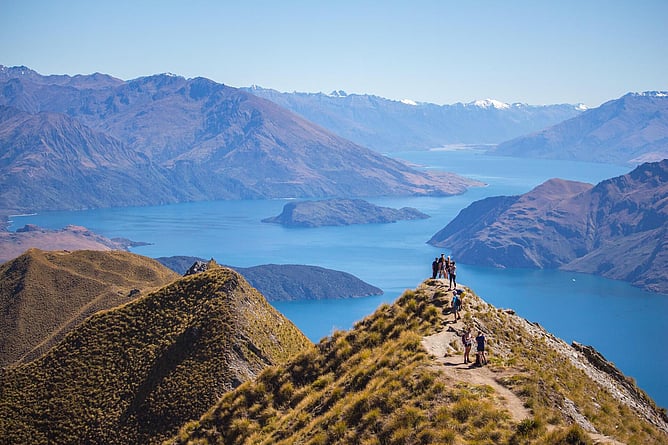
The classic alpine choice: lake-and-mountain scenery, snow-capped peaks even in summer, and some of the country's most photographed backdrops. Queenstown has a mature, well-established wedding industry with experienced local vendors and a wide range of venues, from lakefront properties to high-country stations.
The trade-off is access and weather. Queenstown has its own regional airport, but most international guests will still land in Auckland first and need a separate domestic flight or a long drive to reach it. The climate is also more volatile than the North Island: Queenstown sits in a mountain basin where conditions can shift from clear and still to windy and overcast within the same afternoon, and alpine roads like the Crown Range can be affected by snow, ice or fog outside summer, occasionally closing with short notice.
Nearby Fiordland, home to Milford Sound, is one of the wettest inhabited places on Earth — average annual rainfall in the range of 6,400 to 6,800 millimetres across roughly 180 rainy days a year — so any ceremony or photography trip that depends on reaching that specific location on a specific day needs contingency planning, not a token backup.
None of this rules Queenstown out; thousands of couples marry there every year. It just means outdoor ceremonies and any off-site photography need a wet-weather and cold-weather plan built in from the start, and the region carries a real cost premium, especially during the November–March peak.
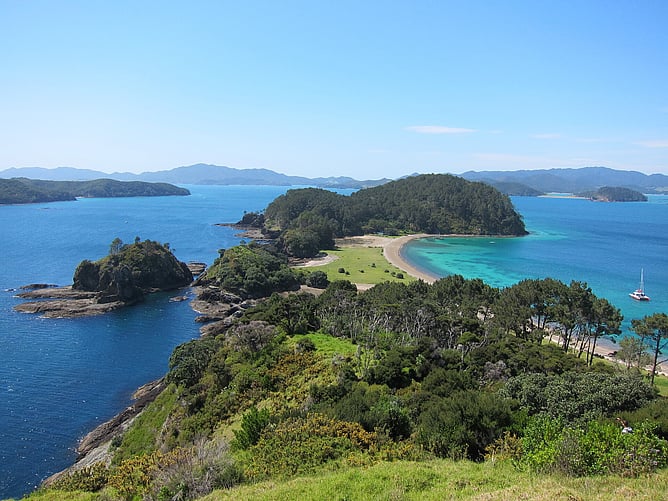
Bay of Islands
New Zealand's classic subtropical beach setting: white sand, sheltered harbours, and a warmer climate than most of the rest of the country, with a strong sailing and maritime history that shows up in a lot of the venue character. It's a three-to-four hour drive or a short domestic flight north of Auckland.
Like Queenstown, it involves an additional leg after the international flight into Auckland, and the wedding industry here is smaller and more resort-oriented than Auckland's, which can mean fewer vendor options at the highest end but often a more relaxed, holiday-resort planning experience.
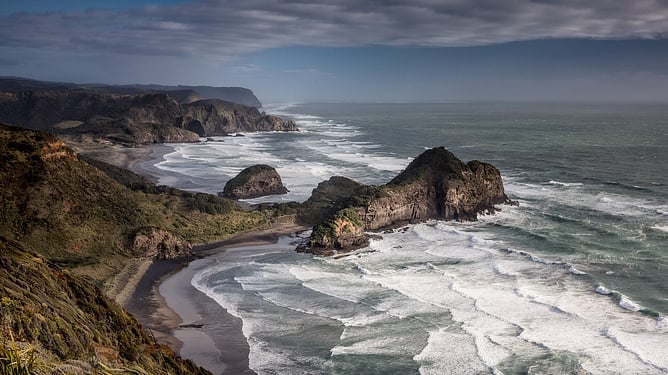
West Auckland
For couples who want the scenery and atmosphere of a destination wedding without asking international guests to take another domestic flight after arriving in New Zealand, West Auckland offers a useful middle ground.
The area west of Auckland city, including Waimauku, Kumeū, Muriwai, Piha and the wider Waitākere area, is roughly 30 to 45 minutes from Auckland Airport. Guests can arrive through New Zealand's main international gateway and travel directly to their accommodation or wedding venue rather than adding another flight to the itinerary.
The area also gives couples several different settings within a small geographic area:
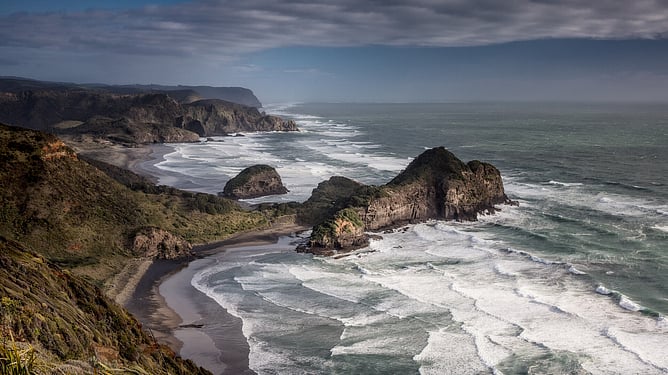
Muriwai and Piha offer black-sand beaches, volcanic cliffs and a rugged Tasman Sea backdrop.
The Waitākere Ranges provide native bush, waterfalls and forest scenery without requiring a trip to the South Island.
Kumeū and Waimauku are surrounded by vineyards and rural properties, giving couples a countryside setting close to Auckland.
Wedding venues such as Settlers Country Manor offer a more traditional estate setting for couples who want gardens, landscaped grounds, a dedicated wedding venue, and a 5-minute drive to Muriwai beach while keeping guest travel straightforward.
That combination can be useful for an international guest list. Someone flying from Australia, the UK or the US can arrive in Auckland, stay in or around the city, and reach the wedding without another domestic flight. Guests can also combine the wedding with time in Auckland, nearby wineries, beaches and other parts of the North Island.
For couples deciding between New Zealand's major wedding regions, this is the main practical difference with places such as Queenstown or the Bay of Islands: West Auckland can provide a destination setting while keeping the wedding close to the country's main international arrival point.
Hawke's Bay
A wine and food region on the North Island's east coast, known for its art deco architecture in Napier and a warmer, drier climate than most of the country. It's an internationally recognised wine destination in its own right, with a correspondingly developed events industry — full-service vineyard venues, established caterers, and wineries used to hosting large functions. It sits a few hours' drive from Auckland, or a short separate domestic flight.
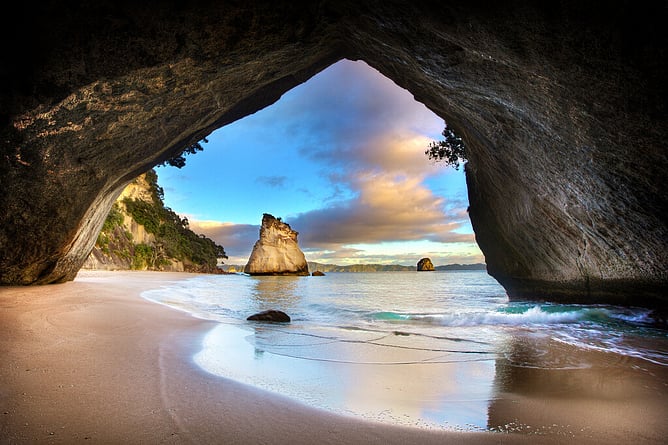
Coromandel Peninsula
Beach and native bush scenery with a laid-back, less built-out feel than New Zealand's bigger wedding regions — a quieter, more secluded option for couples who want a smaller-scale, less heavily booked setting. It's a few hours' drive from Auckland and doesn't have its own international airport, so it involves a longer transfer for guests than some other North Island options.
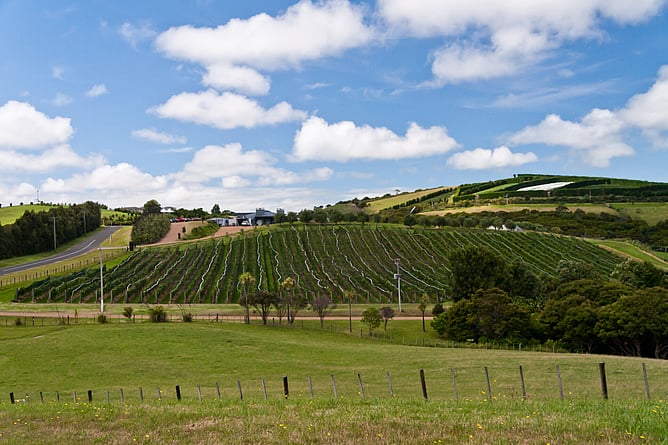
Waiheke Island
Vineyards and coastline reached by a short ferry from downtown Auckland. It has a well-established, somewhat higher-end wine-tourism industry of its own, with venues built around function and event hosting, and an island setting that gives weddings here a distinct sense of occasion.
Tailor It To Your Needs
Whichever region a couple chooses, the underlying trade-offs are broadly the same ones: how much additional domestic travel guests will need to take on, how predictable the weather is, how saturated (and therefore how priced) the region's wedding industry is, and what kind of scenery matters for the day itself. None of the regions above gets all four for free — it's a set of trade-offs to weigh against what matters most to a given couple and guest list.
How Much Does a Wedding in New Zealand Cost?
It's worth being direct about this: New Zealand doesn't undercut other popular destination wedding countries on price. It isn't a budget option in absolute terms. Tourist-heavy regions like Queenstown carry a real premium on venue hire, accommodation and vendors, especially during the November–March peak season when demand is highest and availability tightest. Couples researching this often arrive expecting "destination wedding" to mean "cheaper wedding" — largely because the total bill drops when the guest list shrinks — but the cost per guest is often comparable to a wedding at home, once travel premiums for vendors and any guest hosting (welcome dinners, accommodation blocks) are factored in.
Some estimated numbers help put that in context. As of 2025, the average New Zealand wedding runs roughly NZD $30,000–$45,000 for a guest count in the 80–100 range, though where in the country you marry moves that figure substantially:
Auckland: often NZD $40,000–$55,000 or more, driven by venue demand and supplier pricing in the country's biggest market.
Regional venues: places without the "destination" label attached can come in lower, often NZD $25,000–$35,000 for a comparable day.
Queenstown and similar tourist-heavy destination venues: may exceed NZD $50,000, once premium venue rates, supplier travel costs, and accommodation for a visiting vendor team are factored in.
Smaller or off-peak weddings: fewer guests, a weekday, outside the December–February window — can land under NZD $20,000 with careful planning.
For a more complete breakdown of the estimated cost, read our New Zealand Wedding Industry Report of 2025.
For couples budgeting in AUD, GBP or USD, it's worth converting these NZD figures at the actual exchange rate close to your wedding date rather than relying on a rule of thumb, since currency movements over a 12–18 month planning window can shift the real cost of a New Zealand wedding by a margin either way. As a broad planning gesture only, NZD figures have historically tended to sit somewhat below AUD and noticeably below GBP and USD in nominal terms.
Practical Notes for Planning a Destination Wedding in New Zealand Remotely
Paperwork: Notice of intended marriage is generally lodged online at least three working days ahead of the ceremony, and can be lodged up to twelve months in advance. Confirm current requirements with the Department of Internal Affairs closer to your date.
Timing: November–March is peak wedding season nationwide, and the busiest, most expensive window in tourist-heavy regions like Queenstown. Regions with milder, more consistent year-round climates, including Auckland, offer more flexibility outside that window, both in pricing and in weather reliability.
Lead time: 12–18 months is typical for a New Zealand destination wedding, largely to give overseas guests enough notice to arrange flights and take leave from work.
Weather contingencies: For any outdoor ceremony, but especially in the South Island, build a wet-weather and cold-weather plan rather than a token backup — this includes covered space, heating if needed, and enough schedule slack that a delayed transfer or closed road doesn't derail the day.
Vendor coordination: Because most couples can't visit more than once or twice before the wedding, the number of separate vendor relationships that have to be managed entirely by email, across time zones, is a real factor. Venues offering in-house catering and coordination, or a local wedding planner engaged early, both reduce that overhead considerably compared to sourcing every vendor independently from overseas.
Extending the trip: If minimising backtracking matters to your guest list, a wedding based near Auckland Airport allows a single arrival point with flexible onward travel in any direction, rather than a domestic leg dedicated solely to reaching the wedding itself.
Common Questions About NZ Destination Weddings
Do we need to be New Zealand citizens or residents to marry there?
No. There's no residency requirement. Couples who are both ordinarily resident overseas give notice online, generally at least three working days before the ceremony.
How does New Zealand's legal process compare to Bali, Mexico or Thailand?
It's simpler and less layered. Bali, Mexico and Thailand typically require translated, notarised documentation and, in many cases, a separate legal registration process either before, during, or after the destination ceremony, since the ceremony itself may not automatically be recognised as a legal marriage back home. New Zealand's process is a single, English-language system with no translation or blood-test requirements.
How many guests typically make the trip for a New Zealand destination wedding?
Fewer than a comparable wedding at home. Travel time and cost naturally filter the guest list regardless of planning. Venue capacity varies widely by property and region, so it's worth confirming any venue can flex to your expected numbers rather than assuming.
Can specific cultural or religious traditions be accommodated?
It depends entirely on the venue. Ask directly about prior experience with your customs, catering requirements (halal, kosher, vegetarian-heavy menus, and so on), and ceremony structure before booking — general "multicultural wedding" marketing doesn't guarantee experience with your particular tradition.
Is a New Zealand destination wedding cheaper than marrying at home?
Usually not per guest, once travel premiums for vendors and any guest hosting are factored in. The total bill often drops mainly because the guest list is smaller, not because the country itself is a discount option.