If you are wondering how does muslim wedding work, the short answer is that the religious core is simple and short, while the celebration around it can be big, colourful and multi-day.
A Muslim wedding centres on the Nikah, the Islamic marriage contract. Around that contract, families add cultural traditions, meals and celebrations that vary widely by country, community and family. That is why no two Muslim weddings look exactly the same, even though the religious steps stay consistent.
How Does Muslim Wedding Work?
A Muslim wedding works in two layers: a short religious contract, and a cultural celebration around it.
The religious core is the Nikah. A Nikah is the Islamic marriage ceremony and contract: the couple gives free consent through an offer and acceptance, called ijab and qubul, in front of witnesses, the mahr is agreed, and the nikahnama is signed.
Once that contract is complete, the couple are married in Islam. Everything else, the henna night, the procession, the big dinner, the dancing, is culture and family choice, not a religious requirement.
In practice, it usually works like this:
1. Agreement: The couple agree to marry, families meet, and practical details are discussed.
2. Mahr agreed: The groom's gift to the bride is agreed before the ceremony. This belongs to the bride, it is not a payment to her family.
3. Nikah ceremony: Consent is given, the offer and acceptance are stated before witnesses, and the marriage contract is signed.
4. Announcement: The marriage is announced publicly, often with prayers, sweets and family photos.
5. Walima reception: The groom's family hosts a celebratory meal to share the news. Walima is the wedding reception banquet and is performed after the nikah, to announce the marriage openly and show domestic happiness.
The Nikah itself can happen in a mosque, at home, or at a venue, and can take as little as 30 minutes. The full celebration can be one day or several days, depending on culture, budget and family tradition.
That is why two Muslim weddings can look completely different and still follow the same religious process. The contract stays the same, the celebration changes.
What to Expect at a Muslim Wedding?
If this is your first Muslim wedding, expect warmth, hospitality, lots of food and a strong focus on family and community.
Most celebrations are built around three parts: pre-wedding gatherings, the Nikah ceremony, and the Walima reception. Some couples keep everything to one day in a mosque, home or venue. Others spread events across several days, especially in South Asian, Arab, Turkish, African and Southeast Asian communities.
A few practical things often surprise first-time guests:
Seating may be separate or mixed. Some families seat men and women separately for the ceremony, others seat everyone together. Follow the signs or ask an usher.
There may be prayer breaks. If the celebration runs across prayer times, guests may be invited to pause or use a prayer room.
Food is halal. Expect generous, often buffet-style food. Alcohol is usually not served at a religious Muslim wedding, although some culturally focused receptions may differ.
The mood is celebratory, not solemn. The Nikah itself is respectful and prayerful, but the events around it often include music, dancing and lively family celebrations, depending on the couple's culture and beliefs.
The best rule is to follow the invitation. It will usually tell you the venue, dress code, start time and whether events are split by gender or family.
What Are the Steps of a Muslim Wedding?
While every family does it differently, most Muslim weddings follow the same religious flow. The cultural events before and after can change, but these core steps are what make the marriage valid in Islam.
Step 1: Proposal and Agreement
Families meet, the couple agree to marry, and practical details are discussed. The proposal in Islam is expected to be formal, often made to the woman or to her entire family.
Step 2: Mahr Agreed
The groom's gift to the bride is agreed before the ceremony. A Mahr, a gift from the groom to the bride, is agreed upon before the ceremony.
Step 3: Nikah Ceremony
Offer and acceptance are made before witnesses, and the contract is signed. This is the moment the couple become married in Islam.
Step 4: Announcement and Celebration
The marriage is announced publicly, often with sweets, food and family photos.
Step 5: Walima Reception
The groom's family hosts a celebratory meal to share the news with the wider community.
Not every step looks the same. In some communities the Nikah and Walima happen on the same day. In others, the Nikah happens weeks earlier, and the public celebration comes later. Both are normal.
What Happens at a Muslim Wedding Ceremony?
The ceremony itself is called the Nikah, sometimes spelled Nikkah. It is both a spiritual act and a legal contract.
Here is what typically happens, in order:
Welcome and seating: Guests arrive and take their seats. The couple may sit together or separately, depending on family custom.
Opening and sermon: The officiant, often an imam, opens with a prayer and a short sermon, known as the Khutbah al-Nikah, about marriage, responsibility and kindness.
Consent and offer and acceptance: The officiant asks the bride and groom for consent. The offer, ijab, and acceptance, qabul, are stated clearly in front of witnesses.
Mahr confirmed: The agreed Mahr is stated or confirmed. This is not a dowry paid to the bride's family. It is the bride's own gift and right, and it can be money, jewellery, property or another agreed item.
Signing the Nikahnama: The couple, wali and witnesses sign the marriage contract, called the Nikahnama.
Dua and congratulations: A prayer is made for the couple, sweets are often shared, and guests offer congratulations.
In some traditions, the bride and groom say “Qubool Hai,” meaning “I accept,” three times each when asked. In others, the wali speaks on behalf of the bride, or the couple answer once. The wording varies, but the meaning is the same: free, clear consent.
The Nikah can take place in a mosque, at home or at a venue. It does not need elaborate decoration to be valid. What matters is consent, witnesses, Mahr and the contract.
What Are Muslim Wedding Traditions?
Religious requirements and cultural traditions are not the same thing, and this is where Muslim weddings get their variety.
The religious requirements are the Nikah, consent, witnesses, Mahr and announcement. Everything else is culture, and families choose which traditions to keep.
Common traditions you might see include:
Mehndi or Henna Night: A joyful pre-wedding event, often for women, where henna is applied to the bride's hands and feet. In South Asian weddings it is often a full party with music and dancing.
Sangeet: A musical evening, common in South Asian families, with family performances, singing and dancing before the wedding.
Barat: The groom's arrival with family and friends, often with music, dancing and celebration, especially in Pakistani and Indian weddings.
Rukhsati: An emotional farewell when the bride leaves her family home to start married life. It is often one of the most moving moments of the day.
Zaffa: A celebratory procession with music and dancing, common in Arab weddings, to welcome the couple.
Arsi Mushaf: In some South Asian traditions, the couple look at each other for the first time as husband and wife in a mirror, often with the Quran between them.
Other families keep things very simple, with just a Nikah and a meal. Neither approach is more or less Islamic. The traditions reflect where the family comes from, not a single global rule.
What Is Walima in Muslim Wedding?
Walima is the wedding reception banquet and is performed after the Nikah. It designates a feast in Arabic and is used as a symbol to show domestic happiness in the household post-marriage, and to announce the marriage openly.
In simple terms, the Walima is the meal that celebrates the marriage and shares the news.
Key points to know:
Who hosts it: Traditionally, the Walima is hosted and paid for by the groom or his family. In Islam, it is a strongly recommended Sunnah hosted and paid for exclusively by the groom or his family.
Why it matters: It is considered a Sunnah, a practice recommended in Islam, because it publicly announces the marriage and expresses gratitude.
When it happens: Usually after the Nikah, often the same evening or the next day, but sometimes a few days later.
What it is not: It is not the same as the bride's family's pre-wedding or Nikah-day meal. Some families host both, but the Walima itself belongs to the groom's side.
The scale varies hugely. A Walima can be dates and tea at home, a restaurant dinner for close family, or a banquet for hundreds of guests. The size does not change its meaning.
What Happens at a Muslim Wedding Reception?
The reception is usually the Walima, and it is where most guests spend most of their time.
Expect a warm, social event built around food and family. A typical reception includes:
Arrival and mingling: Guests greet the couple and families, take photos and find their tables.
Couple's entrance: The couple are welcomed in, often to music and applause.
Meal: A large shared meal is the centrepiece. Dishes depend on culture, from biryani and kebabs to Middle Eastern mezze, Indonesian dishes or a modern buffet.
Speeches and prayers: Family members or the imam may offer a short speech or prayer for the couple.
Cake cutting or sweets: Some couples cut a cake, others share traditional sweets.
Dancing and celebration: Depending on the family, there may be first dances, cultural dances, a DJ or live music. In more conservative families, the celebration may be quieter, with separate spaces and no dancing.
Unlike some Western receptions, there is not usually a long list of formal toasts with alcohol, bouquet toss or speeches from many friends. The focus stays on hospitality, gratitude and community.
If you are unsure where to sit, what to do or when to eat, ask a family member or usher. Guests are expected to be looked after, not to figure everything out alone.
How Long Does a Muslim Wedding Last?
This is one of the most common questions, because the answer depends on whether you mean the ceremony or the whole celebration.
The Nikah ceremony itself is brief, typically lasting 15 to 30 minutes. However, the full celebration, including pre-wedding rituals like Mehndi and the post-wedding Walima, can span from 3 to 7 days, depending on cultural traditions and the families' preferences.
Other guides put the Nikah at 30 to 45 minutes, depending on the imam and how many traditions the couple include.
Use this as a guide:
Nikah only: 30 to 60 minutes
Nikah plus reception on one day: 3 to 6 hours
Full multi-day celebration: 2 to 7 days, with different events each day
Walima alone: Often 2 to 4 hours, sometimes up to two days in large family celebrations
Your invitation is the best guide. If it lists only one event, plan for that event. If it lists Mehndi, Nikah and Walima, each one is a separate gathering with its own start time.
How to Dress for a Muslim Wedding as a Guest?
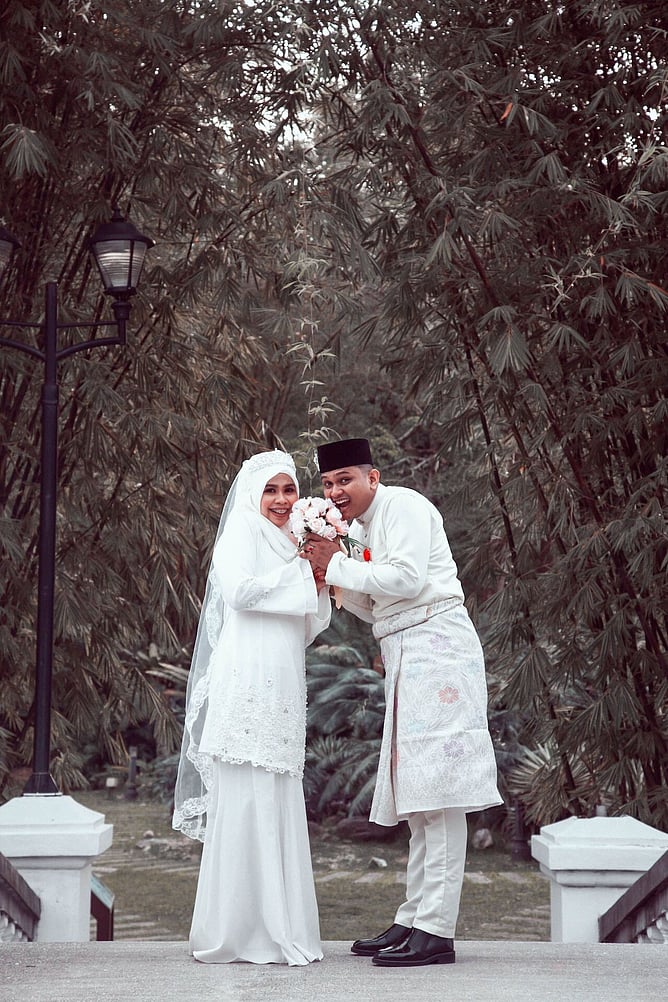
Modesty is the guiding principle. Muslim weddings vary widely based on the couple's cultural background, the formality of the event, and whether any part takes place in a mosque, so there is no single universal dress code. What ties every scenario together is one principle: modesty.
That does not mean boring. Muslim weddings are often very elegant, colourful and formal.
For women:
Choose a long dress, maxi skirt, wide-leg trousers or a traditional outfit like a shalwar kameez, abaya or saree if you own one.
Cover shoulders, chest and knees. Avoid sheer fabric without lining, strapless styles or very tight fits.
Bring a light scarf or pashmina. You may need to cover your hair if any part is in a mosque, or if hosts ask women to cover their hair.
Dress expectations vary with the couple's culture and family, and as a general guide female guests are expected to dress conservatively, covering the arms, legs and chest with loose-fitting clothes.
For men:
Choose formal trousers and a shirt, a suit, or traditional wear like a kurta, thobe or sherwani.
Cover shoulders and legs. Avoid shorts, sleeveless tops or very casual wear.
If the event is in a mosque, you may be asked to remove shoes. Wear clean socks.
Colours and extra tips:
Bright colours, jewel tones and pastels are welcome at most Muslim weddings.
White is often fine, but check the invitation. In some South Asian weddings the bride wears red, in others white or gold.
Avoid all-black if you can. It is not forbidden, but some families associate black with mourning, and a colourful outfit fits the celebration better.
Always check the invitation for a dress code or colour theme. If it says formal, traditional or festive, follow that over a general rule.
When in doubt, dress one step more formal and more covered than you would for a Western wedding. You will blend in and feel comfortable.
How to Congratulate the Muslim Couple
Congratulating the couple is simple, and a heartfelt prayer means more than a perfect phrase.
The traditional Islamic congratulation is:
Barakallahu laka wa baraka alaika wa jama'a bainakuma fi khair
It means: May Allah bless you, bless your union, and bring you together in goodness.
It is recommended that you congratulate the bride and groom by reciting this Hadith, where the Prophet said: May Allah bless your side and bless your counterpart and may Allah tie your union with virtue.
If you are not Muslim, you do not need to say the Arabic phrase. These all work well:
Congratulations, Mabrook! Wishing you both a lifetime of happiness.
Congratulations on your Nikah! So happy for you both.
Wishing you a blessed marriage filled with love, peace and joy.
Barakallahu feekum, congratulations to you both.
For a card or message, try:
Congratulations on your marriage! Wishing you both a lifetime of love, mercy and happiness together. Barakallahu laka wa baraka alaika wa jama'a bainakuma fi khair.
Avoid jokes about divorce, comments about the bride's appearance in a sexualised way, or overly personal remarks. Keep it warm, respectful and focused on their future together.
What to Bring to a Muslim Wedding?
You do not need to bring a large gift to be a good guest, but a thoughtful gift is appreciated.
Common options include:
Money in an envelope: Very common and practical, especially in South Asian and Arab families. Give what you can afford.
Gift from a registry: If the couple shared a registry or wishlist, use it.
A thoughtful household gift: Homeware, a quality serving dish or a gift card is a safe choice.
Food or sweets: Only if you know the family well and know they will welcome it. Otherwise, money or a registry gift is simpler.
If you are unsure, ask a close family member of the couple. They will tell you what is customary for that family.
FAQs: How Does Muslim Wedding Work
Do Muslim couples need to have a big wedding?
No. A simple Nikah with witnesses, Mahr and a small Walima is fully valid. Large celebrations are cultural choice, not religious requirement.
Can non-Muslims attend a Muslim wedding?
Yes. Non-Muslim friends, colleagues and family are often invited and warmly welcomed. You do not need to be Muslim to attend, pray or dress in a specific religious way, but modest dress and respectful behaviour are appreciated.
Is there dancing and music at a Muslim wedding?
Sometimes. It depends on the couple's beliefs and culture. Some weddings have a DJ and dancing all night. Others have nasheeds, cultural music or no music at all. Follow the lead of the hosts.
Final Thoughts
So, how does muslim wedding work? At its heart, it works through consent, a contract and community.
The Nikah makes the marriage official. The Walima shares it with the world. The traditions around them add colour, music, food and family history.
If you are attending as a guest, you do not need to know every ritual. Dress modestly, arrive on time, bring a warm congratulation and enjoy the hospitality. That is more than enough to honour the couple and their families.