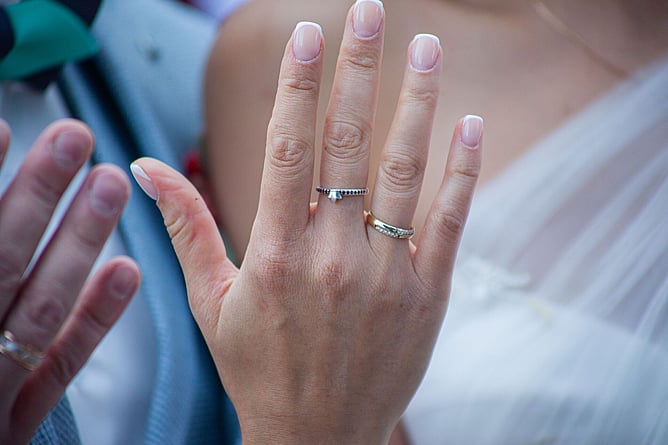
Rings are one of the few wedding traditions almost everyone recognises, yet plenty of couples still have questions as the day gets closer. Does the engagement ring stay on for the ceremony? Which finger does each ring go on? Do the two rings even need to match? This guide answers all of that.
Is an Engagement Ring and a Wedding Ring the Same?
No. They are two different rings that mark two different moments.
An engagement ring is given at the proposal. It usually features a centre stone, such as a diamond, sapphire, moissanite or lab-grown gem, and often has a more elaborate setting. It signals a promise to marry.
A wedding ring, or wedding band, is exchanged during the ceremony. It is typically a simpler band in gold, platinum, silver or another metal, sometimes set with small stones. It symbolises the marriage itself and is traditionally worn every day afterwards.
Some couples blur the lines. A few choose one ring that does both jobs, or skip the engagement ring altogether and go straight to wedding bands. There is no rule that says you must have both, only tradition.
Which Hand and Which Finger?
In New Zealand, Australia, the UK, the US and most English-speaking countries, both rings are traditionally worn on the fourth finger of the left hand, the one next to your little finger. This is commonly called the ring finger.
Customs vary around the world:
In Germany, Austria, Poland, Russia, Norway and several other countries, wedding rings are often worn on the right hand.
In some Orthodox Christian traditions, the ring goes on the right hand.
In India, practices vary by region and religion, and the left or right hand may be used.
In some cultures, the engagement ring is worn on the left and the wedding band moves to the right after the ceremony, or the reverse.
If you or your partner come from a culture with a different custom, wear your rings the way that feels meaningful to you. Many couples blend traditions, and no one will mind which hand you choose.
Why Is the Wedding Ring Worn on the Left Hand?
The most popular explanation goes back to ancient Rome. The Romans believed a vein ran directly from the fourth finger of the left hand to the heart, which they called the vena amoris, or “vein of love”. Wearing a ring there was seen as a way of linking a promise to the heart.
Modern anatomy tells us there is no special vein, as every finger has a similar blood supply. But the romantic idea has stuck for centuries.
There are practical theories too. For most people, the left hand is the non-dominant one, so a ring is less likely to get scratched or damaged during everyday tasks. Religious and cultural customs also helped cement the left hand as the standard in many Western countries.
Whatever the origin, the left ring finger is now simply the tradition, and the story behind it is part of the charm.
Do You Wear Your Engagement Ring on Your Wedding Day?
Yes, most brides and grooms who have an engagement ring do wear it on the wedding day. There are a few common ways to handle the ceremony itself:
Wear it on your right hand for the ceremony. This keeps the left ring finger free for the wedding band to be placed on. After the vows, you move the engagement ring back to your left hand, usually above the new wedding band.
Leave it with someone you trust. Some people give the engagement ring to a bridesmaid, a parent or the best man for safekeeping and put it back on after the ceremony.
Wear it on your left hand throughout. Some couples simply slide the wedding band on below the engagement ring during the exchange. This works well if the rings sit comfortably together.
Skip it entirely. If your engagement ring is large, spiky or high-set, you might choose to wear only the band on the day. That is a personal choice.
Whichever you pick, tell your celebrant or ring bearer beforehand so there are no awkward moments at the exchange.
How to Wear a Wedding Ring and Engagement Ring
When both rings are on the same finger, the traditional order is the wedding band closest to the hand, with the engagement ring on top (further from the palm). The thinking is that the wedding band is “closest to the heart” and the engagement ring sits above it like a crown.
A few tips for making the two rings look and feel right together:
Check the fit of the settings. If your engagement ring has a high centre stone or a curved profile, a straight wedding band may sit awkwardly beside it. A curved or “contour” band is made to nestle against the engagement ring.
Consider a ring guard or spacer. These can fill gaps and stop rings from twisting or spinning.
Try a soldered or stacked set. Some couples have the two rings joined, while others prefer to keep them separate so each can be worn alone.
Think about metals. Matching metals look neat, but mixing yellow, white and rose gold is a popular modern look.
Allow for swelling. Fingers can swell in warm weather, so a ring that feels snug in the morning may be tight by the afternoon. If your wedding falls in the New Zealand summer, try your rings on at different times of day before the big date.
How Long Before the Wedding Should You Sort Your Rings?
Order wedding bands at least two to three months ahead, especially if you want engraving or a custom design. Take your engagement ring along to a jeweller so they can check how the two sit together, and ask about resizing, since this can take extra time.
Frequently Asked Questions
Can I wear my wedding ring on my right hand?
Yes. Many people do, for cultural, practical or personal reasons.
Which comes first, the wedding ring or the engagement ring?
The wedding band is traditionally put on first, followed by the engagement ring on top.
Do men wear engagement rings?
Some do. Engagement rings for men are becoming more common, though many men wear just a wedding band.
What if my rings don’t fit together well?
A jeweller can recommend a contour band, a ring guard or small adjustments to the setting.
Should I take my rings off for everyday activities?
Many people remove them for gym sessions, swimming, gardening and heavy cleaning to avoid damage or loss.