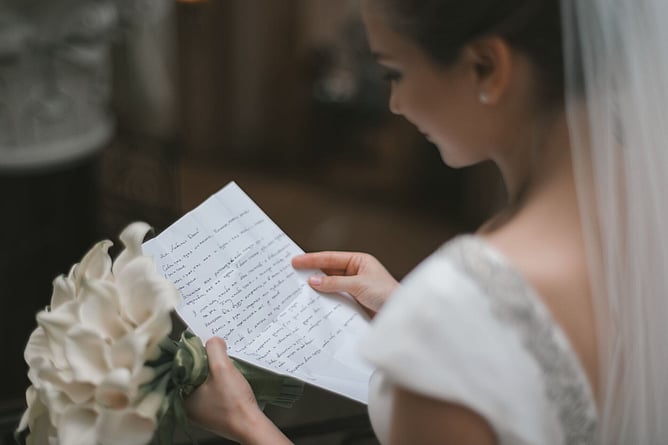
For many couples, the vows are the emotional centre of the whole wedding day. They are the one moment when the music stops, the guests go quiet and you say out loud what your partner means to you. They are also the part many people dread writing.
If you are staring at a blank page wondering how to write wedding vows, take a breath. Good vows are not about being poetic or funny or clever. They are about being honest. This guide walks you through everything: what vows are, where they come from, what to include, how long they should be, and how to open and close them. You will also find original examples you can adapt.
What Are Wedding Vows?
Wedding vows are the promises you make to your partner during your ceremony. They are spoken commitments about how you intend to love, treat and stand by each other for the rest of your lives.
Vows come in two broad forms. Traditional (or set) vows use established wording, often handed down through religious or cultural customs. Personal vows are written by you, in your own words. Many couples combine the two, saying a short set of traditional phrases and then adding a few lines of their own.
It is worth knowing that your vows are separate from the legal side of getting married. In New Zealand your celebrant or officiant will explain the legal declarations required for the marriage to be valid. Your personal vows sit alongside those, so you have a lot of freedom in what you say.
Where Do Wedding Vows Come From?
The idea of spoken marriage promises is very old. In ancient Rome and in early Jewish and Christian traditions, couples made public pledges to bind a marriage, and a spoken agreement in front of witnesses was the heart of the ceremony.
The wording most English speakers recognise today comes largely from medieval church rites in England. These were collected and standardised in the Book of Common Prayer in the sixteenth century. That is where phrases like "to have and to hold" and "for better, for worse" entered everyday language, and they have shaped wedding ceremonies in many countries ever since.
In recent decades, couples have increasingly moved toward writing their own promises. This reflects a wider shift: weddings are now seen as a chance to express your own values and relationship rather than only follow a script. Other cultures bring their own rich traditions as well, from blessings and sacred readings to spoken pledges made in te reo Māori, Hindi, Mandarin, Arabic and many other languages. Including words from your own heritage is a lovely way to personalise your vows.
What Are the Traditional Wedding Vows?
The most familiar traditional vows follow a pattern that many people can recite from memory. In essence, each partner promises to have and to hold the other from this day forward, for better or for worse, for richer or for poorer, in sickness and in health, to love and to cherish until death parts them.
These phrases endure because they are simple and they cover everything. They acknowledge that marriage includes good times and hard times, and they commit you to both. Some versions add a promise of obedience, though most modern ceremonies leave that out, and many celebrants now offer updated wording that is equal and gender neutral.
Traditional vows are a good choice if you:
feel nervous about speaking in front of a crowd
want the ceremony to feel timeless and familiar
belong to a faith or cultural tradition with set wording
like the idea of repeating the same words that generations before you have said
You can also use them as a foundation and then add a personal line or two at the end.
What Do Wedding Vows Consist Of, and What Are They Supposed to Say?
There is no rulebook, but most vows, traditional or personal, are built from the same handful of ingredients. If you know them, you will never be short of something to say.
An address. You speak directly to your partner, usually starting with their name.
An expression of love or gratitude. A sentence or two about what they mean to you.
Specific memories or qualities. The details that make your relationship yours.
Promises. The core of the vows: what you commit to doing, being and protecting.
A statement of lasting commitment. An acknowledgement that you are in this for the long haul, through good and difficult times.
A closing line. A final sentence that seals the moment.
So what are wedding vows supposed to say? Simply this: who you are to each other, what you are promising, and that you mean it. Everything else is decoration. If your vows do those three things, they are doing their job.
How Long Should Wedding Vows Be?
Aim for between one and two minutes of speaking time. For most people that works out to roughly 150 to 250 words, or about 10 to 20 sentences. Anything shorter can feel rushed. Anything much longer risks losing the room, and it is hard to keep your composure when you are emotional.
A few practical points will help:
Read your vows aloud with a timer. Words that look short on paper often take longer when you are speaking slowly and nervously.
Agree on a rough length with your partner. You do not need identical vows, but it can feel awkward if one of you speaks for 30 seconds and the other for five minutes.
If you are using traditional vows, they usually take under a minute, which gives you room to add a short personal message.
Remember that you will speak more slowly on the day. Pauses, tears and laughter all add time.
Short and sincere almost always beats long and rambling.
How to Write Wedding Vows: A Step-by-Step Process
Here is a simple process you can follow if you are not sure where to begin.
Decide on your style. Traditional, fully personal, or a mix. Talk with your partner so you are on the same page, and check with your celebrant or officiant for any rules or timing.
Brainstorm without editing. Spend 15 minutes jotting down memories, inside jokes, qualities you love, moments you knew this was the person, and things you have learned from them.
Choose your key message. What is the one thing you most want your partner to hear? Build the vows around that.
Draft the structure. Opening, a short story or description, your promises, then a closing line.
Write the first draft quickly. Do not worry about polish. Just get words down.
Walk away for a day. Returning with fresh eyes makes it easier to cut what is not working.
Read it aloud. Fix any sentence that feels awkward in your mouth. Vows are meant to be heard, not read.
Trim and finalise. Cut anything that feels generic or longer than necessary, then print a clean copy to hold on the day.
How to Start Wedding Vows
The opening sets the tone, and it is where many people get stuck. The good news is that you do not need a dramatic first line. A calm, warm, direct beginning is the most effective.
Here are some reliable ways to open:
Use their name and speak directly. "Sam, from the moment we met, I have felt completely at home with you."
Start with a memory. "The first time you made me laugh so hard I couldn't breathe, I knew I was in trouble."
Express gratitude. "Thank you for being the person I get to come home to every day."
State how you feel right now. "Standing here today, surrounded by the people we love, I am the happiest I have ever been."
Begin with a short quote or line that means something to you, then tie it back to your relationship in your own words.
Avoid starting with a long apology for being nervous or a joke that needs lots of set-up. A single sentence that speaks to your partner will settle you both.
What to Promise in Wedding Vows
Promises are the backbone of your vows. The strongest ones are specific, realistic and rooted in your actual relationship. "I promise to love you forever" is lovely, but "I promise to always listen before I react" tells your partner something real.
Here are categories of promises to draw from:
Love and respect. To honour them, value their opinions and treat them with kindness, even when you disagree.
Support. To back their dreams, celebrate their wins and stand beside them in hard moments.
Honesty and communication. To tell the truth, to talk things through and to never go to sleep hoping a problem disappears.
Patience and forgiveness. To accept that you will both make mistakes and to choose grace.
Partnership. To share the load, make decisions together and build a home that feels like a team effort.
Daily habits. To make them a cup of tea in the morning, to put your phone down at dinner, to keep dancing in the kitchen.
Family. If you are blending families or planning children, to love and care for them as part of your shared life.
Growth. To keep learning about each other and keep choosing each other, even when life gets busy.
A good mix is two or three big-picture promises and two or three small, playful or practical ones. The small ones are often what guests remember.
How to Make Your Wedding Vows Personal
Personal vows do not need to be fancy. They just need to sound like you, and only you, could have written them. Here are some ways to get there.
Use real stories. A specific moment, such as the road trip where you got lost or the awkward first date, is far more powerful than a general statement about love.
Include the small details. The way they hum while cooking, the playlist you share, their terrible puns. These specifics make your partner feel truly seen.
Write the way you speak. If you are not a flowery person, do not force flowery language. Plain, heartfelt words land best.
Bring in humour, gently. A laugh or two can lighten the mood and show your relationship is full of joy. Keep it affectionate rather than teasing, and leave out anything that could embarrass them.
Reference shared values or culture. A word in your first language, a family saying, a line from a song or book that belongs to you both.
Mention what your partner has changed in you. How life is different, better or braver because of them.
Avoid clichés unless you mean them. If "my best friend" is genuinely how you feel, say it, but add a detail so it is unmistakably yours.
A helpful test: read a sentence and ask whether it could be said by anyone about anyone. If yes, add a detail only the two of you would know.
How to Write Wedding Vows for Him
There is no single way a groom, or anyone writing for a male partner, should sound. The best approach is to write for the specific man you are marrying, not a stereotype. That said, these tips tend to help:
Lead with what he values. Does he prefer humour, quiet sincerity or practical commitment? Match your tone to his, so the words feel like a gift he will recognise.
Be concrete. Many people respond most to specific memories and clear promises. Mention a moment that made you certain, or a habit of his that you adore.
Name what he does for you. If he shows love through actions, such as fixing things, cooking, driving or showing up, say so. Telling him you notice those things can be deeply moving.
Make it easy to hear. If your partner is not one for big displays of emotion, a short, warm, honest message will often mean more than a long one.
Include a promise of partnership. Something like, "I promise to be on your team, always."
Here is a short example you could adapt:
"Tom, you are the calmest person I know, and you make me calmer too. You make every ordinary day feel like an adventure. I promise to listen when you need to talk, to give you space when you need quiet, and to laugh with you, especially when things go wrong. I promise to cheer for you in everything you do, and to build a home with you where we both feel safe. I choose you today, and I will keep choosing you every day after."
If you are the groom writing your own vows, the same principle applies: write to her, not to the audience. Imagine you are speaking to your partner alone.
How to Write Wedding Vows for Her
Again, the aim is to write for the individual, not a type. Here are tips for writing vows to a bride or a female partner:
Reflect her personality. If she is playful, let your vows be playful. If she is thoughtful and reflective, take a gentler, more heartfelt approach.
Tell her how she has changed your life. Many people love hearing what they bring to their partner's world.
Acknowledge her strengths. Her kindness, her determination, the way she handles hard days. Specific compliments feel like real recognition.
Use sensory memories. The place you first met, the song playing, what she was wearing, the way she laughed. Small scenes bring vows to life.
Promise both comfort and adventure. Partners often want to hear that you will be a steady presence and also an exciting one.
Here is an example to adapt:
"Mia, you have taught me what it means to be brave, to be kind and to be completely myself. When I'm with you, I feel like the best version of me. I promise to love you through busy weeks and quiet weekends, to say sorry first when I need to, and to always make time for us. I promise to celebrate your dreams as if they were my own. Today I give you my heart, my loyalty and my whole self, for all the days ahead."
Forget what vows are "supposed" to sound like and describe the actual person in front of you.
How to Write Christian Wedding Vows
Christian wedding vows are rooted in the idea of marriage as a covenant, a sacred promise made before God as well as before family and friends. They often draw on Scripture and on the traditional liturgy of the church, and they typically include promises of faithfulness, love and lifelong commitment.
Here is how to approach writing them:
Talk to your minister or priest first. Many denominations have set vows, or specific requirements about what must be said. Your minister can tell you where there is flexibility and where there is not.
Start with the traditional structure. The familiar promises to love and cherish, in sickness and in health, until death parts you, form a beautiful foundation.
Weave in Scripture. Common choices include 1 Corinthians 13 on the nature of love, Ruth 1:16 ("Where you go I will go"), Genesis 2:24 on two becoming one, and Ephesians 5 on love and respect between partners. Choose a passage that has personal meaning for you both.
Include faith-centred promises. For example, to pray together, to put God at the centre of your home, to grow in faith as a couple, and to raise any children in the faith.
Add a personal layer. Even within a traditional service, you can often add a few lines in your own words about what your partner means to you.
Here is a sample you can adapt:
"In the presence of God, our families and our friends, I take you to be my husband, my wife, my partner for life. I promise to love you as Christ loves us, with patience, kindness and forgiveness. I will honour you, pray for you and walk beside you in joy and in hardship. I will be faithful to you and trust God to guide our home. From this day forward, for better or worse, for richer or poorer, in sickness and in health, I give myself to you, until death parts us."
You can swap the wording to suit your denomination, and adjust the relationship term to fit your own ceremony.
How to End Wedding Vows
The ending is the part everyone remembers, so it deserves a little care. A strong close usually does one of three things: it restates your commitment, it looks ahead to the future, or it brings the vows full circle.
Some effective ways to finish:
Restate your commitment. "I choose you today, tomorrow and for all the days that follow."
Look ahead. "I can't wait to see what our life together becomes."
Return to your opening. If you began with a memory or a phrase, echo it in the final line so the vows feel complete.
Use a simple declaration of love. "I love you, and I always will."
Hand it back to the officiant. A line such as "With all that I am, I am yours" signals you are finished and leads naturally into the ring exchange.
A couple of tips: end on a short sentence rather than a long one, and pause for a second before you stop. A clear final line helps your officiant, and your guests, know it is time to smile, cheer or reach for the tissues.
Common Mistakes to Avoid
Leaving it to the last minute. Give yourself a couple of weeks so you can revise without pressure.
Including inside jokes guests will not understand. One is fine. A string of them leaves everyone else out.
Making them too long. Keep to around two minutes.
Sharing too much. Skip anything embarrassing, private or likely to make your partner uncomfortable.
Forgetting to practise. Reading aloud several times helps you stay steady on the day.
Writing for the audience. Your vows are for your partner. The guests are just lucky to listen in.
Tips for Delivering Your Vows on the Day
Print your vows in a large, easy-to-read font, or write them in a small notebook or on cards you can hold.
Do not memorise unless you feel confident. Reading from a page is completely normal and no one will mind.
Speak slowly, breathe, and look at your partner whenever you can.
Ask your officiant to hold a spare copy, just in case.
If you cry, pause and take a breath. Guests will love it. It means you mean what you say.
Final Thoughts
Learning how to write wedding vows comes down to three things: knowing what you want to say, being specific, and speaking from the heart. Start with a simple structure, a warm opening, a few honest promises and a clear closing line, and you will already have something far more meaningful than any perfectly polished speech.
Your partner is not grading your writing. They are listening for the sound of your voice saying that you choose them. Say that sincerely, and your vows will be exactly right.
Frequently Asked Questions
Do wedding vows have to rhyme or be poetic? No. Plain, honest language is usually the most moving.
Should we write our vows together or separately? Most couples write separately so the words are a surprise, but agree on length and tone beforehand.
Can we read our vows from paper? Yes. Many couples do, and it is completely acceptable.
Can we mix traditional and personal vows? Absolutely. A short set of traditional phrases followed by a few personal lines is a popular choice.
Do we need to tell our celebrant what we plan to say? It is a good idea to share the length and general tone, and some officiants like to see the words in advance.