The wedding ceremony is the heart of the day. The photos, the speeches and the dancing all follow from it, but the ceremony is the moment two people actually become married. It is also the part couples often know the least about when they start planning. How long will it take? Who stands where? Who is allowed to officiate? What are we legally required to say?
This guide answers all of those questions in plain language. It covers what a wedding ceremony is, why it matters, who can perform one in New Zealand, what to include, the typical running order, how long ceremonies last in different cultural and religious traditions, who sits where, and what happens afterwards.
What Is a Wedding Ceremony?
A wedding ceremony is the formal event at which two people publicly commit to one another and, in most places, become legally married. It is distinct from the wedding reception, which is the celebration that follows. You can have a ceremony without a reception, and a reception without a large ceremony, but the ceremony is the part that carries legal and, for many couples, spiritual weight.
Ceremonies come in many forms. A religious ceremony follows the rites of a faith and is usually led by a priest, minister, rabbi, imam, granthi, pandit or another religious leader. A civil ceremony is secular and is led by a government-appointed official or an independent celebrant. A cultural ceremony may combine traditions from the couple's families, and many couples in New Zealand hold more than one ceremony, such as a legal ceremony in a garden followed by a traditional rite later the same day or in another week.
In New Zealand, most ceremonies today are personalised. Couples work with a celebrant to write their own vows and choose readings, music and rituals that reflect who they are, while still meeting the legal requirements.
What Is the Purpose of a Wedding Ceremony?
A wedding ceremony serves several purposes at once.
It makes the marriage legal. The ceremony is where the couple make their declarations in front of an authorised celebrant and witnesses, and where the legal paperwork is signed. Without it, there is no recognised marriage.
It is a public promise. Speaking vows in front of family and friends makes the commitment visible and gives the people who love you a role in supporting it. Guests are not just spectators. They are witnesses and, in a sense, a community promising to back you up.
It marks a transition. Ceremonies are rites of passage. The processional, the exchange of rings and the pronouncement all signal a change in status, for the couple and for their families.
It honours faith, culture and family. For many couples, the ceremony is where heritage is expressed through blessings, rituals, language, clothing and music handed down through generations.
It sets the emotional tone for the day. The ceremony is usually the most reflective, personal part of the wedding. Many couples say it is the part they remember most clearly.
Who Can Perform a Wedding Ceremony in New Zealand?
In New Zealand, only an approved celebrant can legally solemnise a marriage. Hosting a ceremony led by a friend or family member does not, on its own, create a legal marriage. The people who can perform a legal wedding ceremony are:
Independent marriage celebrants. These are people appointed by the Registrar-General of Births, Deaths and Marriages and published in the New Zealand Gazette. They are available to the public, and many specialise in personalised ceremonies. They set their own fees.
Organisational celebrants. These are celebrants nominated by an approved church or organisation, such as a religious body or a group with recognised philosophical or humanitarian convictions. They conduct ceremonies for that organisation's members. This covers many ministers and priests.
Registry office celebrants. Registry ceremonies are simple, short and carried out during office hours, with a set fee for the ceremony in addition to the marriage licence.
A few important points to keep in mind:
There is no "one-off" celebrant. A friend or relative cannot apply to be a celebrant just for your wedding. If you would like a loved one to take part, they can do a reading, give a blessing or lead a symbolic ritual, while a registered celebrant handles the legal parts.
Justices of the Peace are not automatically celebrants. A JP has to apply separately and be approved to solemnise marriages.
It is an offence to pretend to be a celebrant. Always confirm that your celebrant is registered. You can check the public celebrant register run by Births, Deaths and Marriages.
The ceremony must be in person. The couple, the celebrant and the witnesses must be physically in the same place. A wedding cannot be solemnised over a video call.
You need a marriage licence. You must apply for a marriage licence at least three working days before the ceremony, and you will need to name your celebrant and the place where the wedding will happen.
You need two witnesses. They must understand what is happening and be able to identify both of you. Your celebrant can explain the details.
Because requirements and fees can change, check the latest information on govt.nz before you book.
What Should Be Included in a Wedding Ceremony?
Every ceremony needs a few legal essentials, and then it is up to you.
The legal essentials (New Zealand)
A celebrant who is approved to solemnise marriages on the day.
A valid marriage licence naming the couple and the celebrant.
Two witnesses present.
The couple's full names used at least once during the ceremony.
The couple's declarations of marriage, spoken to one another in the presence of the celebrant and witnesses.
Signing of the marriage documents by the couple, the celebrant and the witnesses.
The elements most couples include
A welcome. The celebrant greets guests and sets the tone.
A reading, poem or blessing. Often read by a friend or relative.
The vows. Many couples write their own, which can be personal and short. Others choose traditional wording.
The exchange of rings. A symbol of an unbroken commitment.
The pronouncement. The celebrant declares the couple married.
The kiss or other closing gesture.
Music. For the entrance, the signing, and the exit.
Optional personal and cultural touches
A unity ritual such as a candle, sand blending or handfasting.
A tea ceremony, garlands, a sacred fire, a ketubah signing or the breaking of a glass, depending on your traditions.
A karakia, a whakatau or a waiata, or a blessing in te reo Māori or another language.
Readings in more than one language.
Moments to acknowledge loved ones who cannot be there.
Involving children in the vows or a family promise.
Keep in mind that the more elements you add, the longer the ceremony will be. A rule of thumb is to include what is meaningful and remove what is only there because it is expected.
The Typical Order of a Wedding Ceremony
Every ceremony is different, but a Western-style civil or Christian-influenced ceremony usually follows this shape.
Guests arrive and are seated. Ushers or the bridal party help guests find their seats. Music plays softly.
Seating of family. Grandparents, then parents of the couple, are seated. The groom's parents and the bride's parents are often seated last before the processional.
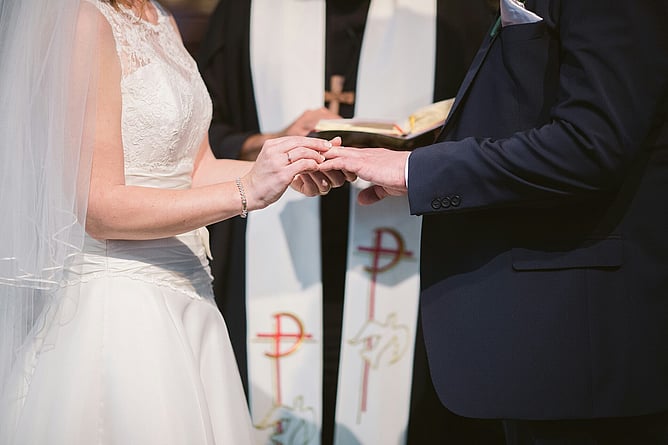
The processional. The celebrant, the partner who will be waiting at the front, the wedding party and the couple enter in turn. The typical entrance order is the groomsmen and bridesmaids, then the ring bearer and flower girl, then the person walking down the aisle, either accompanied by someone they have chosen or alone.
Welcome and opening words. The celebrant welcomes everyone, introduces the couple, and says why everyone is gathered.
Acknowledgements or a blessing. In New Zealand this may include a karakia or an acknowledgement of the land.
Readings, music or a short address. A friend or relative may read or sing.
Declaration of intent. The celebrant confirms that both people are there freely.
The vows. Traditional or personal vows, including the legally required declarations.
The exchange of rings. The ring bearer or best man hands the rings over.
Optional ritual. A unity candle, handfasting, a blessing from elders, or another meaningful ritual.
The pronouncement and kiss. The celebrant declares the couple married.
The signing of the documents. The couple, the celebrant and both witnesses sign. Guests are often entertained with music.
The recessional. The newly married couple walk back up the aisle, followed by the wedding party and then parents.
How Long Is a Wedding Ceremony?
A modern civil or non-religious ceremony typically runs for 20 to 30 minutes, and many couples find 20 to 25 minutes the ideal length for keeping guests engaged. The ceremonies below are far more varied. The times given are general ranges only, since the length depends on the family, the officiant, the region and how many rituals are included. Always confirm timing with your officiant.
Indian / Hindu
A Hindu wedding ceremony in the Indian tradition commonly lasts one to three hours, and some regional or very traditional ceremonies run longer. The ceremony takes place under a mandap, with a priest guiding the couple through rituals such as the welcome of the groom, the exchange of garlands, kanyadaan, the sacred fire (agni) and the seven steps (saptapadi). Many ceremonies are accompanied by a full day of related events, such as mehndi, sangeet and haldi.
Christian
A Protestant Christian ceremony is usually 30 to 45 minutes. It generally includes hymns, scripture readings, a short sermon or message, the vows, the exchange of rings and a prayer. If the service includes communion, expect it to run a little longer.
Catholic
A Catholic wedding held within a Nuptial Mass usually takes 45 minutes to one hour, sometimes slightly longer. A Catholic ceremony held outside Mass is shorter, usually about 30 minutes. The rite includes readings, the exchange of consent, the blessing and exchange of rings, and the nuptial blessing. Catholic couples normally need to complete marriage preparation with their parish ahead of time.
Jewish
A Jewish ceremony usually takes 30 to 45 minutes. It takes place under a chuppah and typically includes the signing of the ketubah (marriage contract), the blessing over wine, the exchange of rings, the reading of the Seven Blessings (Sheva Brachot) and the breaking of a glass. The ketubah is often signed before the ceremony begins, so the guests' experience may be shorter than the full process.
Sikh
A Sikh wedding, the Anand Karaj, commonly lasts about 45 minutes to one and a half hours. It takes place in front of the Guru Granth Sahib. The core of the ceremony is the four laavan, hymns recited and sung while the couple circle the holy book. The ceremony is usually preceded by the milni, where the two families greet one another, and followed by the sharing of karah prashad.
Chinese
Chinese weddings often combine a short formal ceremony of about 20 to 30 minutes with a tea ceremony of 30 to 60 minutes, where the couple serve tea to elders and receive blessings and gifts. Customs vary a lot between regions and families. Traditional events such as the door games, the dressing of the bride and the lucky-time scheduling can stretch across the entire day.
Muslim
A Muslim wedding, the nikah, is usually brief, often 15 to 45 minutes. It includes a sermon (khutbah), the consent of both parties, the presence of witnesses, the agreement on the mahr (the gift from the groom to the bride) and prayers. The nikah is frequently held separately from the larger celebration, the walima, which is held later.
Tamil
A traditional Tamil Hindu wedding commonly lasts two to three hours, and fuller traditional rituals may take longer. The ceremony may include the muhurtham (the auspicious moment), the tying of the thali (mangalsutra), the exchange of garlands, the sacred fire and the seven steps. The timing is set around an auspicious time chosen by the priest, so punctuality is important.
Gujarati
A Gujarati wedding usually lasts around two to three hours. It is a Hindu ceremony with distinct customs, such as the Jaimala (garland exchange), Madhuparka (welcome of the groom), Kanyadaan, Mangalphera (circling the fire) and Saptapadi. It is usually accompanied by lively pre-wedding celebrations such as garba and sangeet.
Mormon
For members of the Church of Jesus Christ of Latter-day Saints, a temple sealing is a short ceremony, typically about 20 to 30 minutes, and it is attended by temple-recommend holders only. Couples who wish to include non-member family often hold a civil ceremony or a ring ceremony outside the temple, which usually runs 20 to 30 minutes or longer depending on the programme. In New Zealand, the legal marriage can be solemnised by an approved celebrant.
Nepali
A Nepali Hindu wedding commonly lasts about two to three hours, though the whole programme, including pre-wedding rituals, can span multiple days. The ceremony includes Kanyadaan, the sacred fire, the seven steps and the application of sindoor. Customs differ between ethnic and regional communities such as Newar, Brahmin, Chhetri and Gurung families, so ask your family and officiant what to expect.
Who Sits Where at a Wedding Ceremony
Seating can be a worry, especially when families are large or blended. The traditions below are guides, not rules. Modern couples are very welcome to mix sides, reserve seating for those who need it, or skip the sides completely and let guests sit wherever they like ("pick a seat, not a side").
Parents of the couple
In a traditional Western ceremony, the front row on each side is reserved for parents. The bride's parents usually sit on the left (as you face the front) and the groom's parents on the right. In many modern ceremonies, one or both parents may walk the person they are supporting down the aisle first, and then take their seats. Step-parents are often seated alongside the parents or in the second row, depending on the family's wishes.
Grandparents
Grandparents are traditionally seated just before the parents, in the first or second row, so that they have the best view and easy access in and out.
Siblings
Siblings who are not in the wedding party sit in the first or second row, beside their parents. Siblings who are in the wedding party stand with the couple at the front.
Extended family
Aunts, uncles and cousins sit behind the immediate family, in rows close to the front. Most couples seat extended family from each side together and arrange the order by closeness.
Guests
Friends, colleagues and other guests fill the remaining rows. Reserve seats near the aisle for guests with mobility needs, young children or anyone who may need to step out. A small reserved sign for the first two rows is a gentle way to avoid confusion.
The wedding party (groomsmen, best man, bridesmaids, maid of honour)
The wedding party does not sit during the ceremony. They stand at the front, usually in two lines facing the guests with the couple in the middle. The bride's bridesmaids and maid of honour stand on the bride's side, and the groom's groomsmen and best man stand on the groom's side. The best man and maid of honour normally stand nearest the couple, since they hold the rings and witness the signing.
Ring bearer and flower girl
The ring bearer and flower girl walk down the aisle ahead of the couple. Once they have done their job, they usually sit with their parents in the front row. For younger children, it helps to have a parent or helper ready at the front to take them gently to their seats.
Ushers
Ushers greet guests, hand out any programmes and escort them to their seats. They often help by guiding people to the correct side if the couple prefers, and by making sure the grandparents and parents are seated in order. After the guests are seated, ushers usually take a seat near the back, or join the wedding party at the front.
The celebrant and the witnesses
The celebrant stands at the front facing the guests and the couple. The two legal witnesses are usually close family or friends and often sit or stand near the front so they can sign the documents.
Seating in religious and cultural ceremonies
Seating customs vary a lot between traditions, so ask your officiant:
Hindu ceremonies may seat parents near or at the mandap, with other relatives around it. Seating can be flexible during the longer rituals.
Sikh ceremonies take place in a gurdwara or a similar space where guests sit on the floor facing the Guru Granth Sahib, covering their heads. The families may sit on separate sides of the room.
Jewish ceremonies often have the parents standing under or beside the chuppah, and guests are usually seated without a bride's or groom's side.
Muslim ceremonies may seat men and women in separate areas, depending on the family's preferences.
Chinese tea ceremonies seat the elders in order of seniority so the couple can serve each in turn.
Blended families and sensitive situations
If parents are divorced or do not get along, seat them in different rows, or on separate sides of the aisle, and let each know the plan in advance. A short note to the celebrant and the ushers about who sits where and who should be kept apart avoids awkward moments on the day.
What Comes After the Wedding Ceremony?
Once the celebrant has pronounced you married, the day moves into a more relaxed rhythm.
Signing and paperwork. The couple, the celebrant and the two witnesses sign the marriage documents. The celebrant gives the couple a copy of the particulars of marriage, which is not the same as a marriage certificate. The celebrant registers the marriage with Births, Deaths and Marriages.
Congratulations and photographs. Guests usually greet the couple, and the couple pose for photos with family, the wedding party and groups of friends.
Cocktail hour or canapés. Guests mingle with drinks while the couple finish photographs.
The reception. The couple are announced, and the meal, speeches, first dance, cake cutting and dancing follow. Some couples hold traditional events, such as a bouquet toss or a send-off, towards the end.
Ordering your marriage certificate. After your marriage is registered, you can order your official marriage certificate online from Births, Deaths and Marriages. You will need it for changing your name, updating your passport or applying for visas.
Name changes and admin. If either partner is changing their name, update the bank, passport, driver licence, employer and other records.
The honeymoon or a mini-moon. Many couples take a trip straight away, and others wait until later.
Tips for Planning a Ceremony That Feels Like You
Meet your celebrant early. A good celebrant will guide you through the legal steps, help you write your vows and suggest a running order.
Keep it a comfortable length. Short enough to hold attention, long enough to feel meaningful.
Plan for the weather. If you are holding the ceremony outdoors, have a sheltered backup.
Brief the people with roles. Readers, ushers, witnesses and the wedding party should know where to stand and when to move.
Think about acoustics. A microphone for the celebrant and the couple ensures guests at the back can hear the vows.
Hold a short rehearsal. Even a 20-minute walk-through reduces nerves and mistakes.
Frequently Asked Questions
Do we need a rehearsal? It is not required, but a quick run-through is helpful, especially if children or older relatives have roles.
Can we write our own vows? Yes. In New Zealand you can write personalised vows, as long as the legally required declarations are included. Your celebrant will tell you the exact words.
Can a friend marry us? A friend can lead parts of the ceremony, such as a reading or a blessing, but only a registered celebrant can legally solemnise the marriage.
Can we get married outdoors? Yes. In New Zealand the ceremony can take place at any location named on the marriage licence, which the couple provide when applying for it.
Do we need two witnesses? Yes. Two witnesses must be present and must sign the marriage documents.
How early should we apply for a marriage licence? At least three working days before the ceremony, though it is wise to apply well ahead of time.
Final Thoughts
A wedding ceremony is both a legal event and a deeply personal ritual. Understanding what it is, who can officiate, how long it will take, how the seating works and what happens next makes the planning calmer and the day itself far more enjoyable. Whether you choose a 20-minute civil ceremony in a garden or a multi-hour traditional rite with generations of family present, the best ceremony is the one that reflects the two people at the centre of it.